
R. Nelson Nash, born in 1931, changed the trajectory of personal finance by asking a question nobody in the industry was willing to ask: What if you didn’t need banks at all?
His answer — the Infinite Banking Concept (IBC) — has since empowered hundreds of thousands of individuals to take control of the banking function in their own lives using dividend-paying whole life insurance. This page is our tribute to the man, his philosophy, and his enduring legacy.
TL;DR — Nelson Nash in 60 Seconds
- Born: March 15, 1931, Greene County, Georgia
- Died: March 27, 2019, Birmingham, Alabama (age 88)
- Known for: Creating the Infinite Banking Concept and writing Becoming Your Own Banker (2000)
- Background: Forestry degree, U.S. Air Force veteran, Master Aviator, 35+ year life insurance career
- Core insight: The average American spends ~34 cents of every dollar on interest — recapture that through your own banking system and you change your financial trajectory forever
- Intellectual foundations: Austrian Economics (Mises, Hayek, Rothbard) and Christian stewardship principles
Why Trust This Guide
This article is written and maintained by the team at Insurance & Estates — ranked the #1 life insurance agency on Trustpilot with 280+ verified reviews. Our lead practitioner, Barry Brooksby, is an Authorized IBC Practitioner who met Nelson Nash personally and has designed over 1,000 IBC policies in 25+ years of practice. Our co-founder Steve Gibbs, JD, AEP® brings 15+ years in estate planning law. We don’t just teach Nelson Nash’s work — we’ve built our practice on it.
Table of Contents
- The Life of Nelson Nash
- A Practitioner’s Tribute
- The Austrian Economics Foundation
- Nash’s Faith and Financial Philosophy
- How the Infinite Banking Concept Was Born
- Nash’s Core Teachings
- The Books: A Complete Guide
- Nash’s Legacy and the Future of IBC
- Faith-Based Community Applications
- Frequently Asked Questions
- Next Steps
The Life of Nelson Nash
Early Years and Education
Robert Nelson Nash was born on March 15, 1931, in Greene County, Georgia. He grew up in Athens, Georgia, where he developed the curiosity and work ethic that would define his career. Nash graduated from the University of Georgia with a B.S. in Forestry in 1952 — a background that seems unlikely for a financial revolutionary, but one that profoundly shaped his thinking.
Forestry taught Nash to think in decades and generations. Trees don’t grow overnight. They compound slowly, invisibly, and then the growth becomes undeniable. That patience, that willingness to think 70 years into the future, became the philosophical backbone of everything he later built.
Military Service
Following graduation, Nash married Mary Edwards Williams — also of Athens — and served two years in the U.S. Air Force (1952–1954) as an aerial photo interpreter with Strategic Air Command at March Air Force Base in California. He later joined the North Carolina Army National Guard as a fixed-wing pilot after attending Army Aviation School, eventually earning Master Aviator Wings over a 30-year military career.
Nash was a pilot for over 60 years. He frequently flew his family to destinations across North America in small aircraft — a detail that reveals something about the man. He wasn’t content being a passenger. In the cockpit, in his finances, in his philosophy — Nash wanted his hands on the controls.
From Forestry to Life Insurance
After his Air Force service, Nash worked as a forestry consultant in North Carolina for nine years before moving to Birmingham, Alabama, in 1963. One year later, he made the career change that would alter the course of personal finance: he entered the life insurance business.
During more than 35 years as a life insurance agent, Nash worked with The Equitable Life Assurance Society of the U.S. and with Guardian. His achievements were significant — he was inducted as a Hall of Fame Member by Equitable, earned the Chartered Life Underwriter (CLU) designation, and became a Life Member of the Million Dollar Round Table (MDRT).
But Nash wasn’t building a career in sales. He was building an education in how money actually moves through institutions — knowledge that would prove far more valuable than any commission.
Personal Life
Nash was devoted to his family. He and Mary were married for 66 years until his passing. Together they raised three children: Debby, Barrington, and Kimberly. He was a member of the First Baptist Church of Birmingham for 28 years, a lifelong choir member and frequent vocal soloist, and a voracious reader with particular passion for Austrian economics and history.
Nash passed away on March 27, 2019, in Birmingham, Alabama, at the age of 88, from complications of heart disease. He is survived by his wife Mary, his three children, ten grandchildren, and nine great-grandchildren.
A Practitioner’s Tribute
“I had the pleasure of meeting Nelson Nash, and what struck me most was that he was a much bigger thinker than most people realized. He didn’t get caught up in every little detail — he cared about the concept. He saw something that the entire financial industry missed for 200 years, and he had the courage to teach it when nobody was listening. When he started, he’d show up to seminars and the room was empty. He kept going anyway. That’s the kind of man he was.
Nelson’s book changed my life and my career. I came from the world of variable universal life — watching clients lose money, losing sleep at night, getting the same answer from my mentor: ‘Tell them they’re in it for the long haul.’ That wasn’t good enough. When I discovered what Nash was teaching about high cash value whole life insurance, everything clicked. In 25 years since, I’ve never had a single client call me to ask why they’re losing money. That just doesn’t happen in the world Nelson showed us.
Our team at Insurance & Estates is deeply grateful for what Nelson did to bring this concept to the mainstream. Everything we’ve built — including our evolution into Volume-Based Banking — stands on the foundation he laid.”
— Barry Brooksby, Authorized IBC Practitioner, author of Live Rich, Die Rich, 25+ years in financial services
The Austrian Economics Foundation
Nelson Nash didn’t develop the Infinite Banking Concept in a vacuum. His thinking was deeply rooted in the Austrian School of Economics — a tradition that provided the theoretical framework for his critique of conventional finance and his vision for an alternative.
Understanding Nash’s Austrian influences is essential to understanding why IBC works the way it does. This wasn’t a product pitch dressed up in economic theory. Nash genuinely believed that the mainstream financial system was fundamentally broken, and Austrian economics gave him the language and logic to articulate why.
Key Austrian Principles in Nash’s Work
Subjective Theory of Value. Austrian economics holds that value is determined by individual preferences, not by some intrinsic measure. Nash applied this directly to his critique of traditional financial planning. The financial industry tells you what your money should do. Nash said you should decide — based on your values, your goals, your situation. IBC puts the individual, not the institution, at the center of every financial decision.
Time Preference. The Austrian concept that people prefer present goods over future goods influenced Nash’s approach to long-term planning. Conventional finance exploits high time preference — credit cards, consumer loans, “buy now pay later” — to extract wealth from individuals. IBC reverses this by rewarding patience and long-term thinking, much like Nash’s forestry training taught him to think in generational timescales.
Capital Theory. Austrian economists view capital not as a lump sum but as a structure of heterogeneous tools used in production. Nash saw whole life insurance cash value the same way — not as savings sitting in an account, but as productive capital that could be deployed, recovered, and redeployed indefinitely. Your policy isn’t a piggy bank. It’s infrastructure.
Criticism of Fractional Reserve Banking. Austrian economists are deeply skeptical of fractional reserve banking — the practice that allows banks to lend far more than they hold in deposits. Nash shared this view emphatically. He saw it as legalized wealth extraction and argued that every loan from a traditional bank enriches the institution at the borrower’s expense. His entire concept of “becoming your own banker” was a practical response to this critique.
Business Cycle Theory. The Austrian theory that economic booms and busts are caused by monetary expansion from central banks reinforced Nash’s conviction that individuals should not depend on institutions they can’t control. When the music stops — and it always does — Nash wanted his clients holding their own capital, not trapped in someone else’s system.
Entrepreneurship. Austrian economics places entrepreneurial action at the heart of economic progress. Nash’s IBC encourages individuals to think like entrepreneurs in managing their personal finances — making strategic decisions, taking calculated risks, and building systems that create value over time.
The Economists Who Shaped Nash’s Thinking
Ludwig von Mises. Nash frequently cited Mises’ work, particularly his critiques of central banking and fiat currency. Mises’ argument that government intervention in monetary policy distorts price signals and destroys savings resonated deeply with Nash’s own observations about the banking system.
Friedrich Hayek. Hayek’s insights about the decentralization of knowledge — the idea that no central authority can possess enough information to make optimal decisions for everyone — aligned with Nash’s conviction that individuals should control their own financial systems rather than delegating to institutions or government programs.
Murray Rothbard. Rothbard’s aggressive criticism of fractional reserve banking and his advocacy for a 100% reserve standard influenced Nash’s thinking about the nature of money and banking. Nash didn’t go as far as Rothbard on all points, but the moral dimension of Rothbard’s critique — that fractional reserve banking is fundamentally dishonest — clearly shaped Nash’s worldview.
Hernando de Soto. While not strictly an Austrian economist, de Soto’s work on property rights and formalizing “dead capital” aligns with Nash’s IBC. De Soto’s emphasis on leveraging assets and creating systems that empower individuals economically parallels Nash’s approach of using whole life insurance as a formal, accessible way to store and grow personal capital that would otherwise remain inert in a bank account.
Nash’s Faith and Financial Philosophy
Nelson Nash’s approach to finance was inseparable from his Christian faith. This wasn’t window dressing. Nash genuinely believed that the traditional banking system led people into a form of bondage that Scripture warned against, and that IBC offered a path toward the kind of financial stewardship the Bible calls for.
Biblical Foundations
Nash frequently connected his financial principles to specific biblical texts:
“The borrower is servant to the lender” (Proverbs 22:7) was perhaps Nash’s most-cited verse. He saw this not as ancient poetry but as an accurate description of the modern debtor’s reality — and the primary problem IBC was designed to solve. If you’re always borrowing from banks, you’re always serving someone else’s interests. Become your own banker and you break that chain.
“A good man leaves an inheritance to his children’s children” (Proverbs 13:22) supported Nash’s emphasis on generational wealth transfer. For Nash, IBC wasn’t just a personal strategy — it was a multigenerational one. The policies you build today become the banking system your grandchildren inherit.
“For which of you, intending to build a tower, does not sit down first and count the cost” (Luke 14:28) aligned with Nash’s insistence on thoughtful, long-term financial planning over impulsive consumer behavior.
The Moral Dimension of Finance
Nash viewed finance through an explicitly moral lens. He believed that fractional reserve banking was not just economically unsound but ethically problematic — a system that creates money from nothing, encourages debt, and concentrates wealth in institutions rather than families.
In contrast, he saw IBC as morally aligned with biblical stewardship: you build something real, you manage it responsibly, you use it to serve your family and community, and you pass it forward. The death benefit wasn’t just a financial instrument — it was a legacy of provision.
Teaching Like a Preacher
Nash’s teaching style — conversational, parable-driven, built on stories and analogies rather than spreadsheets — was deeply influenced by his faith tradition. His famous grocery store analogy (more on this below) functioned much like a biblical parable: a simple, memorable story that carries a profound truth.
Those who knew Nash personally noted that he was the same man on stage as he was in the pew — passionate, convicted, generous with his time and knowledge, and genuinely concerned for the financial well-being of the people he taught.
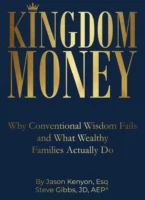
Nash’s Vision, Applied: Kingdom Money
Nash believed Proverbs 13:22 wasn’t poetry — it was a blueprint. A good man leaves an inheritance to his children’s children. Not hopes to. Not tries to. Leaves one. But 401(k)s and IRAs were designed for single-generation consumption — they’re structurally incapable of producing what Scripture describes. Kingdom Money picks up where Nash’s faith-driven philosophy leads — showing families how to build financial infrastructure aligned with God’s design for generational flourishing.
How the Infinite Banking Concept Was Born
The Infinite Banking Concept didn’t arrive fully formed. It emerged from Nash’s personal financial pain, marinated in decades of experience, and was refined through years of teaching before it ever became a book.
The 1980s Interest Rate Crisis
In the early 1980s, Nash was investing in real estate — and getting crushed by interest rates. With mortgage rates exceeding 15%, the cost of borrowing was destroying his returns. He was a successful insurance agent with decades of experience, and he was still trapped in the same system as everyone else: dependent on banks for financing, subject to their rates, operating on their terms.
That frustration, combined with his deep knowledge of whole life insurance mechanics and his Austrian economic training, produced an insight that would change everything: What if the policy I’ve been selling for its death benefit could actually replace the bank?
The Hospital Bed Epiphany
Nash experienced a major heart surgery that became a turning point — not just medically, but philosophically. Lying in that hospital bed, he felt the urgency to get his ideas out into the world. He had spent years toying with the concept, refining it in his own financial life, but hadn’t yet found a way to clearly communicate it to others.
That urgency propelled him into an entirely new phase of his career: teaching.
The Seminar Years
For years before publishing his book, Nash traveled the country delivering seminars on what he was calling the Infinite Banking Concept. These weren’t polished corporate presentations. They were marathon teaching sessions, often lasting several hours, delivered with Nash’s trademark Southern charm and relentless conviction.
Sometimes he spoke to packed rooms. Sometimes the room was nearly empty. He kept going anyway.
Through these seminars, Nash refined his analogies, sharpened his arguments, and discovered which explanations landed and which didn’t. The grocery store analogy, the discussion of Parkinson’s Law, the “34 cents of every dollar” calculation — all of these were forged in the seminar circuit before they ever appeared in print.
Becoming Your Own Banker (2000)
The culmination of Nash’s 20-year journey was the publication of Becoming Your Own Banker in 2000. The book distilled everything he had learned — from forestry, from Austrian economics, from his faith, from his insurance career, from his real estate pain, from a thousand seminars — into a single, accessible volume.
It was self-published. It was unconventional. It was not endorsed by any major financial institution. And it changed the lives of hundreds of thousands of people.
Nash’s Core Teachings
Nash was, above all else, a teacher. His book, his seminars, and his conversations all centered on a handful of foundational principles that he returned to again and again. Understanding these principles is essential to understanding both the man and the concept.
1. “Everything You Buy, You Finance”
This was Nash’s most foundational insight. Whether you borrow money to buy something or pay cash, you’re financing the purchase. If you borrow, you pay interest to someone else. If you pay cash, you lose the opportunity cost of what that money could have earned. Either way, there’s a financing cost.
The question isn’t whether you’ll pay a financing cost. The question is who profits from it. Nash’s answer: it should be you.
2. The 34.5 Cents Calculation
Nash calculated that the average American spends approximately 34.5 cents of every dollar on interest payments over their lifetime — mortgages, car loans, credit cards, student loans, and every other form of financing. This wasn’t a scare tactic. It was the mathematical foundation for his entire system.
If you could recapture even a portion of that 34.5%, redirecting it through a system you control rather than transferring it to financial institutions, the wealth-building implications over a lifetime are enormous.
3. The Grocery Store Analogy
Nash’s most famous teaching tool was his comparison of a whole life policy to running a grocery store:
Your policy is the store. Your cash value is the inventory on the shelves. Paying premiums is stocking the shelves. Taking policy loans is selling goods to customers. Repaying loans is restocking the shelves. Dividends are your store’s profits. And opening additional policies is opening new store locations.
The genius of this analogy is that it reframes life insurance entirely. You’re not buying a product. You’re building a business — one that grows as long as you keep stocking the shelves and serving customers.
Nash emphasized the “front door vs. back door” principle: always repay loans through the front door (with interest, on your terms) rather than defaulting through the back door. An honest banker pays themselves back.
4. Volume Over Rate
This principle was perhaps Nash’s most revolutionary — and most misunderstood — teaching. Traditional financial planning asks: “What return can I get on my savings?” Nash asked a completely different question: “How much of my money is actually working for me?”
If you save 10-15% of your income and chase an 8% return, you’re optimizing a small slice. Nash advocated putting your entire income through your banking system so that the volume of your return — not the rate — becomes the dominant factor in wealth creation.
This is why Nash personally owned 49 life insurance policies at one point. Not because he loved insurance, but because he understood that volume of capital flow determines wealth outcomes more than rate optimization ever will.
For a deeper exploration of how this principle has evolved into a complete methodology, see our guide on Volume-Based Banking.
5. Parkinson’s Law
Nash taught that “expenses rise to equal income” — a principle known as Parkinson’s Law. No matter how much you earn, the natural human tendency is to spend all of it. As Nash put it: “A luxury, once enjoyed, becomes a necessity.”
This is why Nash believed that building a banking system with structured premium payments was so powerful. It creates a forced discipline — a systematic redirection of capital before Parkinson’s Law can consume it.
6. Willie Sutton’s Law
When bank robber Willie Sutton was asked why he robbed banks, he reportedly answered: “That’s where they keep the money.” Nash applied this principle to taxation: wherever money accumulates, someone will try to take it. The IRS, Nash argued, is the most effective wealth extractor in history.
This is why the tax treatment of whole life insurance — tax-deferred growth, tax-free access through policy loans, tax-free death benefit — was so central to Nash’s system. It wasn’t just about building wealth. It was about protecting it from the Willie Suttons of the world.
7. The Arrival Syndrome
Nash warned about what he called the “arrival syndrome” — the tendency to stop building once you feel you’ve “made it.” He saw this as one of the greatest threats to long-term wealth. The person who reaches a comfortable income and stops growing their banking system is leaving enormous wealth on the table.
Nash’s antidote was simple: never arrive. Keep stocking the shelves. Keep expanding. Keep thinking in decades, not years.
8. “Use It or Lose It”
Nash emphasized that the banking function exists in every person’s life whether they recognize it or not. Every major purchase, every financing decision, every dollar that flows through your hands involves a banking function. The question is whether you control it or whether you’ve handed it to someone else.
If you don’t build your own banking system, you don’t eliminate banking from your life. You just ensure that all the benefits flow to institutions instead of to you and your family.
The Books: A Complete Guide to Nash’s Published Works
Nash authored or co-authored three books. Each serves a different purpose, and understanding which to read — and in what order — helps practitioners get the most from his written legacy.
1. Becoming Your Own Banker (2000, 6th Edition)
Best for: Everyone. This is where you start.
Nash’s foundational work introduces the Infinite Banking Concept through a combination of economic philosophy, personal anecdotes, and policy illustrations. The book is organized in four parts: the core concept, the human behavior problems that undermine wealth building (Parkinson’s Law, Willie Sutton’s Law, the Arrival Syndrome), practical implementation steps, and case study illustrations.
What to know going in: The book was written over 25 years ago. The dividend rates Nash references are from a very different interest rate environment. The illustrations in the book use withdrawal-based examples for simplicity, which can confuse modern readers because IBC practitioners actually use policy loans, not withdrawals. Nash prioritized conceptual clarity over mechanical precision — he cared about the idea, not every decimal point. Read it for the philosophy and the principles. For current numbers and implementation specifics, work with a qualified practitioner.
2. Building Your Warehouse of Wealth (2011)
Best for: Those who’ve read the first book and want to go deeper.
This follow-up expands on the concepts in Becoming Your Own Banker with additional context on Austrian economics, the fractional reserve banking system, and how IBC functions within the broader economic landscape. It’s more philosophical than practical — think of it as Nash’s extended meditation on why the system works, not just how.
3. The Case for IBC (2018, with L. Carlos Lara and Robert P. Murphy)
Best for: Readers who want the economic and academic argument.
Co-authored with economist Robert P. Murphy and business consultant L. Carlos Lara, this book provides the most rigorous defense of IBC from an Austrian economic perspective. It addresses common criticisms head-on and provides the kind of analytical framework that Nash’s first book deliberately avoided in favor of accessibility. If you’ve been challenged on the economics of IBC and want the scholarly response, this is the book.
Nash’s Legacy and the Future of IBC
The Nelson Nash Institute
In 2013, Nash helped establish the Nelson Nash Institute (NNI) to formalize the education of financial professionals in the IBC system. The Institute created an Authorized IBC Practitioner Program — a certification that ensures advisors understand Nash’s principles deeply enough to implement them properly.
The NNI continues to operate after Nash’s passing, maintaining the educational standards he established and expanding the community of certified practitioners.
“This Is Nelson Nash” — The Documentary
Released in June 2019, just months after Nash’s passing, the documentary film This Is Nelson Nash tells the story of his life and impact. It was financed entirely through IBC policy loans — a fitting tribute to the principles Nash spent his life teaching. The initial screening at the NNI Practitioners Think Tank in February 2019 was attended by Nash, Mary, and over 200 friends and family members.
What Nash Got Right
The passage of time has vindicated Nash’s core insights. Modern academic research — including studies from Ernst & Young and researchers like Wade D. Pfau — has demonstrated that integrated strategies combining whole life insurance with investments deliver significantly better retirement income and legacy wealth than conventional investment approaches alone. Nash’s intuition, developed through decades of practice and Austrian economic reasoning, has been confirmed by the numbers.
For a full analysis of the research, see our guide on Buy Term and Invest the Difference vs. Whole Life.
Where IBC Has Evolved
Nash was a big-picture thinker. He cared about the concept, not every mechanical detail. And he openly acknowledged that the book’s illustrations were simplified for clarity — a fact that sometimes confused analytically-minded readers.
Since his passing, practitioners have continued to refine and adapt IBC strategies in several important ways:
Policy design has advanced. Modern infinite banking policies are engineered with a precision that wasn’t possible when Nash started teaching. The ratio of base premium to paid-up additions, the approach to the MEC line, and the selection of mutual carriers have all been optimized based on decades of implementation data.
The “volume” principle has matured into a complete methodology. Nash taught that volume matters more than rate. Practitioners have taken that principle and developed it into what we call Volume-Based Banking — a systematic approach to redirecting entire cash flows through a personal banking system rather than optimizing returns on a small savings rate.
Integration with other asset classes has deepened. Nash advocated using policy loans to invest. Today’s practitioners have developed sophisticated frameworks for combining IBC with real estate, business acquisition, debt elimination, and estate planning structures.
Technology has made education more accessible. Nash spent years driving to seminars with empty rooms. Today, his ideas reach millions through educational technology, software calculators, and digital content that would have been unimaginable when he started.
The IUL Question
One area where Nash was unequivocal deserves mention: he was firmly opposed to using Indexed Universal Life (IUL) or Variable Universal Life (VUL) for infinite banking. The Nelson Nash Institute has publicly reaffirmed this position, stating clearly that IBC uses dividend-paying whole life insurance from mutual companies — period.
Nash’s reasoning was straightforward: IBC requires guarantees. Guaranteed cash value growth, guaranteed premiums, guaranteed access. IUL and VUL introduce market variability, surrender charges, and increasing insurance costs that undermine the foundational certainty the system requires.
For a detailed comparison, see our guides on Infinite Banking with IUL and the full pros and cons of IBC.
Faith-Based Community Applications
Nash’s Christian worldview didn’t just shape his personal philosophy — it gave him a vision for how IBC could strengthen entire communities of faith.
Community Banking Applications
Nash envisioned faith communities implementing variations of his banking concept to create supportive financial networks:
Church Building Funds. Rather than traditional debt financing for construction, congregations could establish policies owned by the church that build value while providing access to capital through policy loans.
Ministry Endowments. Using IBC structures to create perpetual funding mechanisms for mission work and local outreach — a growing pool of capital that serves the church’s mission indefinitely.
Pastoral Support. Supplementing often inadequate clergy retirement plans with dividend-paying policies that provide both living benefits and death benefit protection.
Congregation Assistance. Establishing policy pools that allow for flexible support of members facing financial hardship — without the ethical complications Nash associated with traditional lending.
Financial Education as Discipleship
Nash believed churches could serve as centers for financial education. He saw this as part of the church’s discipleship mission — helping believers apply their faith to all areas of life, including how they handle money. Financial literacy seminars, mentorship programs pairing experienced members with younger families, and youth programs teaching stewardship principles were all part of his vision.
His conviction was simple: if the Bible has more to say about money than almost any other topic, then the church has a responsibility to teach its people how to manage it wisely.
Frequently Asked Questions About Nelson Nash
Who was Nelson Nash?
R. Nelson Nash (1931–2019) was an American finance author, life insurance agent, military aviator, and the creator of the Infinite Banking Concept. He wrote Becoming Your Own Banker, which introduced a strategy of using dividend-paying whole life insurance as a personal banking system. His ideas were grounded in Austrian economics and Christian stewardship principles.
What books did Nelson Nash write?
Nash authored three books: Becoming Your Own Banker (2000) — his foundational work on IBC; Building Your Warehouse of Wealth (2011) — a deeper exploration of the economic philosophy behind IBC; and The Case for IBC (2018) — co-authored with L. Carlos Lara and Robert P. Murphy, providing the Austrian economic argument for the concept.
When did Nelson Nash die?
Nelson Nash passed away on March 27, 2019, in Birmingham, Alabama, at the age of 88, from complications of heart disease. He was survived by his wife Mary (married 66 years), three children, ten grandchildren, and nine great-grandchildren.
What is the Nelson Nash Institute?
The Nelson Nash Institute (NNI), established in 2013 with Nash’s involvement, is the official educational organization dedicated to teaching the Infinite Banking Concept. It operates the Authorized IBC Practitioner Program, which certifies financial professionals who demonstrate mastery of Nash’s principles. The NNI continues to operate from Birmingham, Alabama.
Did Nelson Nash use IUL for infinite banking?
No. Nash was explicitly and firmly opposed to using Indexed Universal Life (IUL) or Variable Universal Life (VUL) for infinite banking. He insisted that IBC requires the guarantees that only dividend-paying whole life insurance from mutual companies can provide. The Nelson Nash Institute has publicly reaffirmed this position since his passing.
How many life insurance policies did Nelson Nash own?
Nash personally owned 49 life insurance policies at one point in his career. This wasn’t because he loved buying insurance — it demonstrated his principle that volume of capital flow through your banking system matters more than rate of return on any individual policy. Each policy expanded his personal banking capacity.
What is the Infinite Banking Concept?
The Infinite Banking Concept is a financial strategy that uses dividend-paying whole life insurance as a personal banking system. Rather than storing money in traditional banks and borrowing from financial institutions, you build cash value in your policy and access it through policy loans — while your full cash value continues compounding uninterrupted. For a complete breakdown of how it works, including pros, cons, and implementation details, see our comprehensive IBC guide.
Is Becoming Your Own Banker still relevant today?
The principles are timeless. The specific illustrations and dividend rates in the book reflect conditions from over 25 years ago and should not be taken as current projections. Modern practitioners have refined Nash’s concepts significantly — policy design is more sophisticated, integration with other asset classes is more developed, and the evolution into methodologies like Volume-Based Banking has advanced the practice well beyond what Nash’s book covers. Read the book for the philosophy. For how IBC works today, see our Infinite Banking guide. When you’re ready to implement, schedule a strategy session.
Next Steps
Continue Your Education
If Nelson Nash’s ideas resonate with you, here’s where to go next:
- The Complete Guide to Infinite Banking — How IBC works in practice, with honest pros and cons from practitioners with 1,000+ implementations
- Volume-Based Banking — How Nash’s “volume over rate” principle has evolved into a complete wealth-building methodology
- Becoming Your Own Banker — Book Review — Our comprehensive review of Nash’s foundational work
- Top 10 Best Infinite Banking Companies — Which mutual carriers align with Nash’s criteria for IBC
Ready to Implement?
Our Pro Client Guides will build a custom illustration around your age, health, income, and goals — so you can see what the numbers look like for your specific situation.
Sources
Becoming Your Own Banker by R. Nelson Nash
R. Nelson Nash’s Official Obituary — Nelson Nash Institute
R. Nelson Nash — Wikipedia
The Source of the Source of Nelson Nash’s Infinite Banking Concept — Ryan Griggs
This Is Nelson Nash Documentary — Ascendant Financial