Compound interest is the process of earning interest on both your original principal and on previously earned interest. Over time, this creates exponential growth that dramatically outpaces simple interest — which is why it has long been called “the eighth wonder of the world.” But as financial professional Barry Brooksby puts it: “You cannot have true compound interest in an account where you can lose money or have to pay taxes on the growth.” Understanding how compound interest works — and which accounts actually protect it — is one of the most consequential financial decisions you can make.
In 2026, compound interest accounts range from high-yield savings (up to 4.00–4.35% APY, taxable) to certificates of deposit, money market funds, and cash value life insurance. But the raw interest rate only tells part of the story. Taxes, access restrictions, rate guarantees, and whether you can use your money without interrupting the compounding cycle all determine how much wealth you actually build. A 4.35% taxable return, for example, drops to roughly 3.25% after federal taxes — while a tax-free account at 5.25% keeps every dollar compounding.
This guide breaks down exactly how compound interest works with real calculations, shows how taxes destroy compounding over time, compares every major account type side by side, and identifies which account delivers the strongest compound growth after taxes, fees, and real-world access needs are factored in.
📋 TL;DR: Compound Interest Accounts in 2026
- Simple vs. compound: $10,000 at 4% for 30 years grows to $22,000 (simple) vs. $32,434 (compound) — a 47% advantage.
- Common accounts: High-yield savings (4.00–4.35% APY, taxable), CDs (3.75–4.18%, taxable, locked), money markets, and cash value whole life insurance (3-4%+ guaranteed + 1-2% dividends, tax-free).
- Tax impact matters: A 4.35% taxable return becomes ~3.25% after federal taxes. Tax-free accounts preserve the full compounding effect.
- The velocity factor: Accounts that allow borrowing against your balance without interrupting growth (like whole life policy loans) compound in two places simultaneously.
💡 Bottom Line: The most effective compound interest account combines a competitive guaranteed rate, tax-free growth, and the ability to access funds without stopping the compounding cycle. High cash value whole life insurance is the only account that delivers all three.
✅ Why Trust This Guide
This guide is written by Jason Kenyon, estate planning attorney and CEO of Insurance & Estate Strategies LLC, with over 18 years of experience in financial services. Our team includes licensed estate planning attorneys and financial professionals with independent access to dozens of top-rated mutual insurance carriers. All rates and calculations in this article are verified against current Federal Reserve data, NerdWallet, Bankrate, and Investopedia as of the date shown above. We are not affiliated with any single carrier and recommend products based on client-specific needs.
📊 Current Data Sources & Verification
- Federal Reserve (January 28, 2026): Federal funds rate held at 3.50%–3.75% target range
- FRED Economic Data (February 6, 2026): Effective federal funds rate at 3.64%
- NerdWallet (February 10, 2026): High-yield savings rates up to 4.35% APY (major online banks)
- Fortune / Curinos (February 10, 2026): Top high-yield savings rates up to 5.00% APY (limited, conditional)
- Bankrate (February 6, 2026): Best CD rates up to 4.18% APY
- FOMC Projections (December 2025): One additional 25bp cut projected for 2026, likely mid-year
All rates and data verified February 2026 from primary financial sources
📉 2026 Rate Update: Savings Rates Are Falling — Whole Life Guarantees Aren’t
The Federal Reserve cut rates three times in late 2025, dropping the federal funds rate from 4.50% to 3.75%. High-yield savings accounts have followed, with most top-tier accounts now paying 4.00–4.35% APY — down from 4.66% just months ago. CDs have dropped to around 4.18%. Meanwhile, whole life insurance contractual guarantees remain unchanged because they’re set at policy issue, not tied to Fed policy. This widening gap between falling variable savings rates and stable whole life guarantees makes the case for tax-free compound growth even stronger heading into 2026.
Table of Contents
- Which Accounts Offer the Best Compound Interest in 2026?
- How Do Taxes Destroy Compound Interest Growth?
- What Happens When a Penny Doubles Every Day for 30 Days?
- What Is the Difference Between Compound Interest and Simple Interest?
- How Much Does $10,000 Grow With Compound Interest Over 20 and 30 Years?
- How Often Should Interest Compound? (Daily, Monthly, Yearly)
- How Does Cash Value Life Insurance Work as a Compound Interest Account?
- What Is the Best Compound Interest Account for 2026?
- How Does a Bank Savings Account Compare to Whole Life Insurance?
- How Does Velocity of Money Multiply Compound Interest Growth?
- Next Steps
Which Accounts Offer the Best Compound Interest in 2026?
A number of cash and cash equivalent accounts feature compound interest. Bank savings accounts, mutual fund and brokerage account money market accounts, and life insurance cash accounts typically accrue compound interest. Corporate and government bonds often pay simple interest, although some products offer dividend reinvestment programs which enable compounding. Mutual funds allow reinvestment of both dividends and capital gains if they are open-ended, enabling compounding — but unlike cash accounts, any principal invested in these funds is at risk.
The table below compares every major compound interest account type across the factors that actually determine long-term wealth: after-tax returns, rate guarantees, access to your money, and whether accessing it interrupts the compounding cycle.
| 2026 Compound Interest Account Comparison | |||||||
|---|---|---|---|---|---|---|---|
| Feature | High-Yield Savings | CDs | Money Market | 401k / IRA | Bonds / Bond Funds | Equity Mutual Funds | High Cash Value Whole Life |
| Best For | Emergency fund, short-term parking | Known future expense, rate lock | Short-term liquidity with slightly higher yield | Employer match capture, tax deduction | Fixed income allocation, predictable yield | Long-term growth (accepts market risk) | Tax-free compound growth, uninterrupted compounding, wealth transfer, and financial infrastructure |
| Gross Return (2026) | 4.00–4.35% APY | 3.75–4.18% | 4.0–4.3% | Varies (market-dependent) | 4.0–5.0% | 8–10% historical avg. | 3–4% guaranteed + 1–2% dividends |
| Tax Treatment | Fully taxable annually | Fully taxable annually | Fully taxable annually | Tax-deferred (taxed at withdrawal) | Taxable (interest & capital gains) | Taxable (dividends & capital gains) | Tax-free growth & access |
| After-Tax Return (25% bracket) | ~3.0–3.25% | ~2.8–3.1% | ~3.0–3.2% | Varies (taxed later) | ~3.0–3.75% | ~6.0–7.5% | 5.25%+ (no tax reduction) |
| Rate Guaranteed? | ✗ Fluctuates with Fed | ✓ Locked during term | ✗ Fluctuates | ✗ Market-dependent | ✓ If held to maturity | ✗ Market-dependent | ✓ Contractual guarantee |
| Principal at Risk? | ✗ FDIC insured | ✗ FDIC insured | ✗ FDIC / SIPC | ✓ Market risk | Minimal (if held to maturity) | ✓ Full market risk | ✗ Guaranteed floor |
| Liquidity / Access | ✓ Instant | ✗ Locked (early withdrawal penalty) | ✓ Instant | ✗ 59½ age restriction + RMDs | Varies (maturity dates) | ✓ Sell anytime (at market price) | ✓ Policy loans, no age restriction, no RMDs |
| Compounding Interrupted by Access? | ✓ Withdrawal stops growth on that money | ✓ Penalty + lost interest | ✓ Withdrawal stops growth | ✓ Withdrawal stops growth + penalties | ✓ Must sell to access | ✓ Must sell to access | ✗ Full balance compounds during loan |
| Death Benefit? | ✗ | ✗ | ✗ | ✗ (taxable to heirs) | ✗ | ✗ | ✓ Tax-free to beneficiaries |
| Creditor Protection? | ✗ | ✗ | ✗ | Partial (ERISA plans) | ✗ | ✗ | ✓ Protected in most states |
Rates as of February 2026. Returns on market-based accounts (401k, mutual funds) reflect long-term historical averages and are not guaranteed. Whole life returns reflect contractual guarantees plus non-guaranteed dividends from participating mutual insurers. Individual results vary by carrier, policy design, and health classification.
How Do Taxes Destroy Compound Interest Growth?
The comparison table above shows that high-yield savings accounts pay 4.00–4.35% APY — but that’s the gross rate. After 25% federal taxes, your real return drops to approximately 3.25%. Meanwhile, whole life insurance at 5.25% keeps every dollar tax-free. Over time, this gap compounds dramatically.
| Tax Impact: $10,000 Growing for 30 Years | |||
|---|---|---|---|
| Account Type | Gross Return | After-Tax Return | Final Value |
| High-Yield Savings (Taxable) | 4.35% | ~3.25% | $26,196 |
| Whole Life Insurance (Tax-Free) | 5.25% | 5.25% | $44,565 |
| Tax Advantage | – | +2.00% | +$18,369 (70% more) |
The extreme example below shows how devastating annual taxation can be to compound growth over longer periods.
Here is a chart of one dollar doubling 20 times and that same dollar doubling 20 times but taxed annually at 25%. Notice how paying even a marginal tax rate (25%) can absolutely destroy wealth building.
| Tax Impact: $1 Investment Doubling Annually for 20 Years | ||
|---|---|---|
| Year | Tax-Free Compounding | Taxable at 25% |
| 1 | $2.00 | $1.75 |
| 2 | $4.00 | $3.06 |
| 3 | $8.00 | $5.36 |
| 4 | $16.00 | $9.38 |
| 5 | $32.00 | $16.41 |
| 6 | $64.00 | $28.72 |
| 7 | $128.00 | $50.27 |
| 8 | $256.00 | $87.96 |
| 9 | $512.00 | $153.94 |
| 10 | $1,024.00 | $269.39 |
| 11 | $2,048.00 | $471.43 |
| 12 | $4,096.00 | $825.01 |
| 13 | $8,192.00 | $1,443.76 |
| 14 | $16,384.00 | $2,526.58 |
| 15 | $32,768.00 | $4,421.51 |
| 16 | $65,536.00 | $7,737.64 |
| 17 | $131,072.00 | $13,540.88 |
| 18 | $262,144.00 | $23,696.54 |
| 19 | $524,288.00 | $41,468.94 |
| 20 | $1,048,576.00 | $70,576.64 |
📊 Tax Impact: 93% wealth reduction ($978,000 lost to taxes)
Tax-free grows 15X more than taxable • $1,048,576 vs $70,577 final values
What Happens When a Penny Doubles Every Day for 30 Days?
A popular way to demonstrate the power of compound interest is to ask: would you rather have $1,000,000 or a penny doubled every day for 30 days? Most people choose the million. They shouldn’t.
| Penny Doubling: The Power of Compound Growth Over 30 Days | |||||
|---|---|---|---|---|---|
| Day | Amount | Day | Amount | Day | Amount |
| 1 | $0.01 | 11 | $10.24 | 21 | $10,485.76 |
| 2 | $0.02 | 12 | $20.48 | 22 | $20,971.52 |
| 3 | $0.04 | 13 | $40.96 | 23 | $41,943.04 |
| 4 | $0.08 | 14 | $81.92 | 24 | $83,886.08 |
| 5 | $0.16 | 15 | $163.84 | 25 | $167,772.16 |
| 6 | $0.32 | 16 | $327.68 | 26 | $335,544.32 |
| 7 | $0.64 | 17 | $655.36 | 27 | $671,088.64 |
| 8 | $1.28 | 18 | $1,310.72 | 28 | $1,342,177.28 |
| 9 | $2.56 | 19 | $2,621.44 | 29 | $2,684,354.56 |
| 10 | $5.12 | 20 | $5,242.88 | 30 | $5,368,709.12 |
🎯 Compound Growth Power: The Penny Challenge
Starting Amount (Day 1)
Value at Day 20
Final Value (Day 30)
Growth Rate: 536,870,912% increase over 30 days through daily compounding
Demonstrates exponential growth power • $5.3 million from a single penny • Compound interest in action
What Is the Difference Between Compound Interest and Simple Interest?
Compound interest is best understood by comparison to simple interest:
- Simple interest: Interest earned on invested principal over multiple periods of time that does not take into account the interest earned in earlier periods. In other words, interest is only paid on principal, not on any interest earned on that principal.
- Compound interest: Interest earned on invested principal over multiple periods of time that does account for the interest earned on the principal in earlier periods. Interest is earned on interest plus principal when compound interest is used. It is this “compounding” of principal and interest that creates huge long-term accumulation.
The compound interest example below demonstrates exactly why compound interest is called “the eighth wonder of the world.” When you invest $10,000 at 4% annual interest, the difference between simple and compound interest becomes dramatic over time.
Simple Interest Calculation: Linear Growth
Simple Interest Formula: Principal × Interest Rate × Time
With simple interest, you earn $400 every single year (4% of $10,000), regardless of how much your account has grown.
| Simple Interest at 4% over 30 years | |||||
|---|---|---|---|---|---|
| Year 1 | Year 5 | Year 10 | Year 20 | Year 30 | |
| Starting Value | $10,000 | $11,600 | $13,600 | $17,600 | $21,600 |
| Annual Interest | $400 | $400 | $400 | $400 | $400 |
| Year-end Value | $10,400 | $12,000 | $14,000 | $18,000 | $22,000 |
Compound Interest Calculation: Exponential Growth
Compound Interest Formula: Principal × (1 + Interest Rate)^Time
With compound interest, you earn interest on your interest. Each year’s interest gets added to your principal, making the next year’s interest payment larger.
| Compound Interest at 4% over 30 years | |||||
|---|---|---|---|---|---|
| Year 1 | Year 5 | Year 10 | Year 20 | Year 30 | |
| Starting Value | $10,000 | $11,698.59 | $14,233.12 | $21,068.49 | $31,186.51 |
| Interest Growth | $400 | $467.94 | $569.32 | $842.74 | $1,247.47 |
| Year-end Value | $10,400 | $12,166.53 | $14,802.44 | $21,911.23 | $32,433.98 |
🎯 THE COMPOUND INTEREST ADVANTAGE
$10,000 at 4% for 30 years:
Simple Interest: $22,000
Compound Interest: $32,434
Compound Advantage: $10,434 MORE (47% greater return)
Bottom Line: Compound interest transforms your money into a growth machine where every dollar earned starts earning its own dollars. The longer you let it work, the more dramatic the difference becomes compared to simple interest accounts.
How Much Does $10,000 Grow With Compound Interest Over 20 and 30 Years?
Let’s look back at the above example comparing simple interest to compound interest over 20 and 30 years. This allows us to really start to see the benefits of compound interest kicking in.
$10,000 at 4% simple interest for 20 years would grow to $18,000. Over 30 years at the same rate your $10,000 would grow to $22,000.
Using an online compound interest calculator we can calculate how much the same amount would grow to using compound interest:
Over 20 years at 4% compound interest your $10,000 would grow to $21,911.23 ($3,911.23 greater than using simple interest).
Over 30 years at the same rate it would grow to $32,433.98 ($10,433.98 greater than using simple interest, or 47% greater return with compound interest vs simple interest).
The added time for the compounding to work enables your original investment to grow significantly more than would have been the case if you had received simple interest on the money.
Given that even small amounts can provide substantial growth if they compound over a long enough period of time, it should be readily apparent from these examples that time is of the essence when it comes to maximizing the impact of compound interest on your savings.
The Earlier the Better
The flip-side of this is that if you fail to start saving early enough, it can be very difficult to make up for lost time due to the power of compounding. Consider: $10,000 invested at 5.25% compound interest at age 25 grows to $77,426 by age 65. Wait until 35 and it reaches $46,416. Wait until 45 and you’re looking at just $27,825. That first decade of delay cost you $31,010 — nearly 40% of your potential wealth — because it wiped out the years when compounding accelerates the fastest.
This is not to say that you shouldn’t set aside savings later in life, just that the earlier you start the better. By giving your savings as much time as possible to compound in value, you can maximize the money you are able to amass for your financial goals, whether paying a child’s education, purchasing a home, or providing retirement income.
How Often Should Interest Compound? (Daily, Monthly, Yearly)
While an account earning compound interest grows faster over time than one that is paid simple interest, not all compound interest accounts are compounded on the same schedule.
Some accounts are compounded yearly, some quarterly, some monthly, and some weekly or even daily.
The shorter the compounding time, the more rapidly an account will grow. Thus, an account that has interest compounded monthly will grow faster than one compounded yearly, and an account featuring daily compounding will grow faster than one compounding monthly.
The reason is the compound interest account is being credited interest each day, increasing the principle balance, which increases the effect of the interest credited. The balance “compounds” at a greater rate since interest is credited more often.
To avoid consumer confusion regarding the actual interest rate they are receiving on an investment or being charged on a loan, the concept of an effective interest rate is used.
Also known as an annual percentage rate, or APR, the effective interest rate tells you the actual interest rate you are receiving or being charged on an annual basis. This rate takes into account the frequency of compounding to determine the equivalent yearly rate.
Using an APR enables you to compare different compound interest rate accounts on an apples-to-apples basis when it comes to evaluating the interest rate.
How Does Cash Value Life Insurance Work as a Compound Interest Account?
The cash account in cash value life insurance, also known as permanent life insurance, such as whole life and universal life typically receives compound interest.
After you’ve tended to your immediate liquidity needs by setting aside some cash for emergencies, placing money into dividend-paying whole life insurance can be a good way to build up cash savings.
Specific cash value whole life policies typically feature paid-up additions riders, which allow you to add cash to the account if you like.
What Is the Best Compound Interest Account for 2026?
Whole Life Insurance stands out as one of the most powerful compound interest vehicles available, especially when utilized with the Infinite Banking Concept. As the comparison graphs illustrate:
Unlike traditional financing (where borrowing creates a cycle of progress and setbacks) or conventional bank saving (where withdrawals regularly interrupt growth), Infinite Banking with whole life insurance provides a continuous upward trajectory.
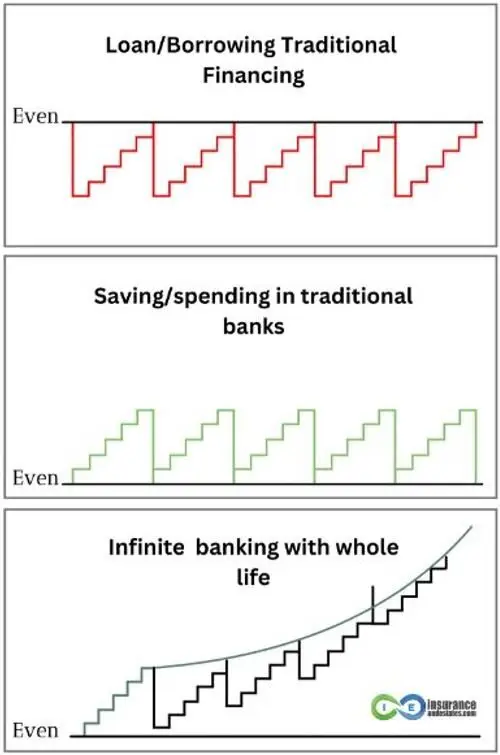
Your Whole Life policy grows cash value at a guaranteed rate plus potential dividends, creating true compound growth where interest earns interest over time. The critical difference becomes clear when you access your money: with policy loans, your entire cash value continues earning compound interest uninterrupted. This happens because you’re not withdrawing money — you’re using your policy as collateral while your full cash value keeps growing.
This creates the unique stair-stepping growth pattern shown in the bottom graph: your money works in two places simultaneously, avoiding the repeated setbacks seen in traditional methods. As your policy matures over decades, this uninterrupted compounding effect becomes dramatically more powerful, significantly multiplying your wealth.
The visual comparison makes it clear why this combination of guaranteed growth, uninterrupted compounding, and financial leverage makes Whole Life Insurance an exceptional compound interest account for building long-term wealth.
How Does a Bank Savings Account Compare to Whole Life Insurance?
In light of our position that whole life insurance is the best compound interest account, please consider the following additional benefits that you receive in a high cash value whole life insurance policy versus a traditional bank savings account to store your “safe bucket” money.
| Traditional Bank Savings Account | High Cash Value Whole Life Insurance Policy | |
|---|---|---|
| Earnings Rate | The national average yield for savings accounts is 0.58 percent APY as of Dec. 18, 2023 (*Bankrate, December 13, 2023). But actual earnings are less after tax and not guaranteed. | Guaranteed (average) 3% interest. Plus an additional 2%-4% dividends. Tax-free, so net earnings of 5%-7%, which may increase as interest rates increase. |
| Withdrawals and Earnings | Amount available for withdrawals is lower because gains in the account are taxable. | Full amount of cash value is available for withdrawals. |
| Loans | Does not offer loans. Loan would have to be obtained through a bank or other lender. | Loans are available via the cash value, with no approval needed. Plus, the amount borrowed still continues to generate interest and dividends. |
| Loan Repayment | Amount and due date of repayments is determined by the bank or lender. If payments are late or missed, it negatively impacts your credit score. | No required loan payments. Policyholder determines when and how much is paid - or even IF payments are made. |
| Added Benefits Upon Death | Paid on Death (POD) to a beneficiary. | Death benefit is paid to beneficiary income tax free. |
| Living Benefits | None | ~Chronic Illness Rider - With a chronic illness diagnosis or need for long-term care, funds may be accessed from the death benefit. ~Accelerated Death Benefit - Death benefit funds may also be accessed in the event of a terminal illness diagnosis. ~Protection from 3rd party creditors - In most states, whole life insurance is protected from creditors, lawsuits, and bankruptcy. |
| Costs | Potential savings and checking fees. | Premium is required for death benefit. However, premium payments are leveraged for a larger death benefit payout - which is received income tax free by the beneficiary(ies). |
| Creditor Protection | Minimal. | Creditor protection based on individual state laws. |
Let’s look more closely at a few of these cash value life insurance benefits.
Highly competitive cash value returns:
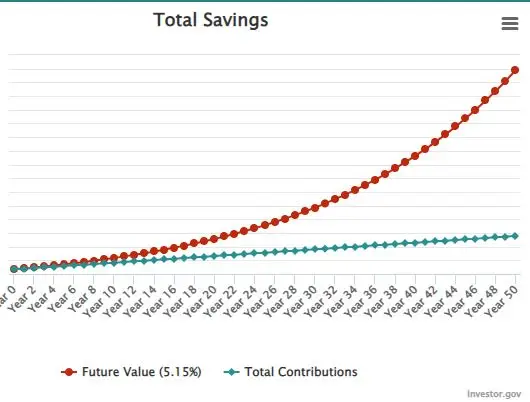
Dividend paying life insurance companies cash value accounts have offered returns that have exceeded those offered by most other cash or cash equivalent accounts in recent years.
With these cash value accounts growing in the range of 3-4% guaranteed, they have rewarded policyholders with highly competitive performance for policyholders.
In addition, although not guaranteed, these mutual companies that offer participating policies have life insurance dividends, that are paid to policyholders income tax free. Dividends can increase your whole life policy return, with many top mutual offering dividends in excess of 6%.
Tax-favored growth:
Interest earned on a cash value account accumulates tax-deferred. This tax-favored growth enables your money to grow faster than would be the case if it were subject to yearly taxes.
You can withdraw earnings on your cash account free of taxation up to the amount of premiums you have paid into the policy, i.e. your basis. Withdrawals over your basis amount are subject to taxes.
Death benefit protection:
Life insurance is a highly effective method of transferring wealth. If your intention is to build up cash savings to protect your loved ones in case something happens to you, the death benefit protection offered by cash value life insurance will typically provide them with a greater amount than the cash value of your account.
Death benefit proceeds are income tax free to the recipient beneficiary. Additionally, you can gift life insurance cash value to your account beneficiaries without the gifts being subject to income or gift taxes providing the cash stays in the policy.
These gifts can take place during your lifetime. This contrasts with vehicles such as 401k plans or IRAs where taxes must generally be paid on funds passed down to your beneficiaries.
Control over your money:
Another advantage of cash value life insurance is that the funds can be withdrawn in the form of a partial withdrawal or you can borrow against your cash value through a policy loan.
Unlike 401ks or IRAs where a penalty typically applies to most 401k withdrawals before age 59 1/2, there is no such restriction on cash value accounts. And there is no required minimum distribution (RMDs) down the road.
Creditor and Bankruptcy Protections:
Many states offer life insurance creditor protection. If you are subject to a judgment or bankruptcy, the cash value in your life insurance is protected from creditors in many states. However, there is a lot of variance from state to state, so make sure you check your particular state’s creditor protection laws.
How Does Velocity of Money Multiply Compound Interest Growth?
This is the most important section of this article because it reveals how your money can grow in two places at the same time. Every other compound interest account forces a choice: either your money sits in the account earning interest, or you take it out to use it. Whole life insurance eliminates that trade-off entirely.
Mutual life insurance companies offer participating policies that pay a guaranteed rate of return plus potential dividends. When you need to access capital, you take a policy loan — borrowing against your cash value rather than withdrawing it. Your full cash value stays in the policy, still earning its guaranteed rate and dividends as if you never touched it.
You then deploy that loan into a cash-flow-producing asset — real estate, a business investment, equipment financing, bridge loans, or any opportunity you choose. Now your money is working in two places simultaneously: compounding inside the policy and generating returns in the external asset.
💰 Velocity of Money Example: $100,000 Working in Two Places
A policyholder with $100,000 in cash value takes a $100,000 policy loan to purchase a rental property.
| Velocity of Money: $100,000 Compounding in Two Places Simultaneously | |||
|---|---|---|---|
| Growth Source | Year 1 | Year 10 | Year 20 |
| Life Insurance Cash Value (5.25% tax-free, uninterrupted) | $105,250 | $166,840 | $278,396 |
| Rental Property Net Cash Flow (8% annual return on deployed capital) | $8,000 | $80,000 cumulative | $160,000 cumulative |
| Less: Policy Loan Interest (5% simple interest on $100K loan) | −$5,000 | −$50,000 cumulative | −$100,000 cumulative |
| Combined Net Position | $108,250 | $196,840 | $338,396 |
Compare this to leaving the same $100,000 in a high-yield savings account at 4.35% (taxable). After 25% annual taxes, that money would grow to approximately $218,911 over 20 years — with no additional cash flow and no death benefit. The velocity strategy produces $338,396 in combined value, a $119,485 advantage (55% more), plus ongoing rental income and a tax-free death benefit.
This is the fundamental difference between saving money and deploying money. Traditional compound interest accounts force you to choose one or the other. Whole life insurance — used as financial infrastructure rather than just a savings vehicle — lets you do both. Your cash value compounds uninterrupted while your deployed capital generates its own returns. The two growth engines stack on top of each other.
This dual-compounding effect is what separates wealth builders who use their money from savers who park their money. And it’s why the compound interest discussion doesn’t end at choosing the highest rate — it ends at choosing the account that lets your capital move without losing momentum.
📘 Beyond the Basics: The Self-Banking Blueprint
If the idea of your money compounding in two places simultaneously resonates with you — if you’ve sensed that conventional saving advice is missing something fundamental — the Self-Banking Blueprint walks through the complete framework step by step. It covers how to structure a high cash value policy for maximum early liquidity, how to use policy loans strategically without disrupting growth, and how this approach fits into a broader wealth-building system designed around the velocity of money.
Next Steps
If you would like to see how your own numbers look, schedule a strategy session with one of our Pro Client Guides to see how powerful a compound interest life insurance strategy can be for you.