I spent twenty years as an estate planning attorney drafting the legal architecture of wealth transfer. The trusts. The entities. The tax structures. The work that families pay attorneys to do when they’re trying to pass what they’ve built down to their kids.
Over those years I came to believe the documents are not where the work actually happens. They are necessary. They are also not the variable that decides whether the transfer to your children works.
So I have shifted my work toward what families actually need. Not as the attorney drafting their documents, but as the person walking alongside them on the part of the transfer that no document can do. That is the framework this article is about. It is the framework I have watched succeed, and fail, across the families I have served over twenty years. It is what the wealth industry does not have language for, because the wealth industry does not have it to give.
TL;DR — Bottom Line:
- The mainstream answer to heir preparation is financial literacy and family meetings. It is not wrong. It is just not the actual problem.
- Wealth does not dissipate across generations because heirs cannot read a brokerage statement. It dissipates because heirs were never formed as people capable of stewarding anything.
- Formation happens in the household, through work and responsibility and ownership, long before any conversation about trusts or portfolios.
- The families who transfer wealth multi-generationally treat the household as the primary training ground. The wealth advisor is a supporting role, not the lead.
- Infrastructure matters. A family bank built on permanent life insurance gives heirs a working environment where formation can actually happen. But the infrastructure without the formation produces trust fund children. The formation without the infrastructure produces capable adults with nothing to steward.
- You need both. And you need to start sooner than you think.
Steve Gibbs is a JD and Accredited Estate Planner (AEP®) with two decades of estate planning. He co-founded Insurance & Estates in 2017 and now works alongside the estate planning attorneys, CPAs, and advisors who handle the technical execution, focusing on the part of the transfer that documents cannot do. The framework in this article reflects what he has watched succeed, and fail, across the families he has served. These are observed patterns from inside the work, not theoretical models.
Table of Contents
- Why “Financial Literacy” Doesn’t Save Wealthy Families
- What Heirs Actually Need: Formation, Not Information
- The Household as the Real Training Ground
- Vocation, Not Career
- Stewardship and the Owner Question
- The Infrastructure That Makes Formation Possible
- Generosity as the Final Test
- Frequently Asked Questions
Why “Financial Literacy” Doesn’t Save Wealthy Families
Read the standard advice on preparing heirs and you will find the same five recommendations in every article. Start money conversations early. Teach budgeting and saving. Hold structured family meetings. Engage a financial advisor to model good practice. Involve the children in philanthropy.
I have nothing against any of these. We recommend several of them at Insurance & Estates as part of broader planning. The problem is not that the advice is wrong. The problem is that it is treated as the answer, when at most it is hygiene.
The most cited research on this question, by Roy Williams and Vic Preisser of The Williams Group, tracked 3,250 families over twenty years through actual wealth transitions. Their finding: 70 percent of wealth transfers fail by the end of the second generation. More importantly, they identified the causes. Sixty percent of failures came from breakdowns in communication and trust within the family. Twenty-five percent came from heirs who were inadequately prepared for the responsibility. The remaining fifteen percent covered everything else combined: taxes, legal issues, poor investment performance, document errors. The conventional wealth conversation focuses almost exclusively on that last fifteen percent.
Here is the test. Take two adult children of wealthy families. Both received the full financial literacy treatment growing up. Both can read a balance sheet. Both attended the family meetings. Both have polite words to say about philanthropy. One of them, at thirty-five, is running a business and reinvesting most of what comes in. The other, at thirty-five, is on her third career, has burned through her trust distributions, and is in family court. Same curriculum. Different outcomes.
What happened in between?
The financial literacy framework cannot tell you. It assumes the problem is knowledge transfer. It treats the heir as a slightly underdeveloped financial professional who needs more education. So the prescription is more education. More meetings. More conversations. More planning involvement.
The wealth industry talks this way because it is the only language it has. A wealth advisor is paid to deliver financial expertise. So the answer to every problem looks like more financial expertise. If heirs are unprepared, give them more financial knowledge. If they squander it, give them more meetings. If meetings fail, hire a family coach. The toolkit does not change because the toolkit is what the industry sells.
But the actual data point sitting in front of any experienced estate planner is this. The heirs who fail are not the ones who lacked financial literacy. They are the ones who lacked something the literacy was supposed to be installed on top of. A foundation. A character. A relationship with work and ownership and responsibility that was built before any of the financial conversations ever started.
The families who succeed know this in their bones. They will sometimes hire the advisors and run the meetings and check the boxes, but they do not believe those activities are doing the actual work. The actual work was done years earlier, in the household, and it was not financial work. It was formation work. The money conversations are a wrapper around something that was either built or wasn’t.
What Heirs Actually Need: Formation, Not Information
There is a word for what the wealth industry will not say. The word is formation.
Formation is the slow shaping of a person into someone capable of certain kinds of work and certain kinds of weight. It is not a curriculum. It is not a series of conversations. It is what happens to a child over years of daily life inside a household that expects something of them. It happens through repetition. Through consequence. Through being trusted with real responsibilities while the stakes are still small enough to recover from failure. Through watching the adults around them do hard things and treat those hard things as normal.
Information is what you give a person who already has the foundation to receive it. Formation is the foundation itself.
This is not a new idea. It is one of the oldest ideas. Every serious culture in history has understood that children are not born ready to receive what their parents built, and that the parents’ main work is not to leave a larger inheritance but to leave heirs capable of stewarding what is left. Read the household manuals of the 17th century English Puritans. Read the Roman writers on the paterfamilias. Read the rabbinic literature on the duties of fathers to sons. The vocabulary is different in each tradition. The conviction is the same. A man’s primary economic responsibility is not the accumulation of wealth. It is the formation of the next generation that will receive it.
What was lost is the framework that made this conviction operational. Industrial-era life pulled fathers out of the home and into factories and offices. Mass schooling pulled children out of the household and into age-graded institutions. The household stopped being the place where children were formed and became the place where they slept between externally-administered formations. The economic life of the family fragmented into individual careers, each pursued in isolation. The category of household economy, which is to say the family operating as a single economic unit producing and consuming and forming its members together, almost disappeared from middle and upper-middle-class life.
What replaced it is the model the wealth industry now serves. Family as a tax-filing convenience. Children as future individual professionals. Inheritance as a lump sum at death. Formation outsourced to schools, universities, employers, therapists. Financial literacy classes at age sixteen.
The families who beat the three-generation pattern have not rediscovered some secret technique. They have, quietly and often without naming what they are doing, reconstituted the household as an economic and formational unit. Their children grow up inside something that asks them to participate. They do real work. They make real decisions. They live with real consequences. By the time they are twenty-five, they have the foundation that financial literacy needs to land on. Then the financial conversations can happen, and they actually take.
This is the order. Formation first. Information second. Reverse it and the information slides off, because there is nothing for it to adhere to.
The Household as the Real Training Ground
So what does it actually look like to treat the household as the training ground?
The honest answer is that it looks like work. Not chores in the modern sense, which is a vestigial concept from a culture that no longer needs children to contribute to household survival. Real work. Work that matters. Work that has consequences if it is not done well. Work the child can see the results of and take responsibility for.
In the families who pass wealth across generations, this starts young and never stops. The five-year-old has a role. The ten-year-old has more. The fifteen-year-old is contributing meaningfully to something the family is doing. By eighteen, the child has been in the orbit of real responsibility long enough that the difference between earned competence and unearned privilege is felt rather than explained.
The wealth industry will sometimes gesture at this. It will say things like, give your child an allowance tied to chores, or have them work a summer job. These are well-intentioned. They are also unserious. A summer job at a chain restaurant is a useful brush with the labor market. It is not formation. The child returns to a household where nothing was asked of them and nothing depended on them. The summer job is an excursion, not a habitat.
The families who do this well have built habitats. The household runs on the contributions of everyone in it. Children grow into expanding rings of responsibility. The fifteen-year-old who has been trusted with the family’s livestock for three years is a different kind of person than the fifteen-year-old who has been trusted with putting their laundry in the hamper. Both have been told they are responsible. Only one has been formed by responsibility.
I have noticed something else watching these families. The work the children do is almost never invented for them. It is real work that the family actually needed done, that the child happens to be able to do at their developmental level. There is no pretense. The work matters. The child can tell. Children always can.
This is where the connection to the broader picture starts to come into view. If a family has built a banking infrastructure, a working enterprise, land that needs tending, properties that need managing, then there is a deep well of meaningful work the children can be drawn into as they grow. A family with only W-2 income and a 401(k) has very little to apprentice their children into. The structure of conventional middle and upper-middle-class life leaves children with no real economic role until they are adults, at which point they enter the labor market as strangers to it.
Families serious about multi-generational wealth often think about this asymmetry early. They do not just plan to transfer assets. They plan to build a household that has enough going on, economically and operationally, that the children grow up inside meaningful work. The wealth becomes a byproduct of that household, not the substitute for it.
Vocation, Not Career
One of the quiet differences between heirs who steward wealth and heirs who dissipate it is how they understand what they are doing with their lives.
The modern frame is career. A career is what an individual pursues. It belongs to the person. It is portable, optimizable, and meant to maximize personal fulfillment and earnings over a lifetime. The career frame is the default frame in nearly every conversation a wealthy parent has with a child about what comes next. What do you want to do? What are you passionate about? What will make you happy?
These are not bad questions. They are also not the questions the families who succeed multi-generationally are asking their children.
The older frame is vocation. A vocation is a calling. It carries the sense of being summoned to a particular kind of work that fits the person and serves something larger than the person. Vocation is not necessarily a job. It is the answer to the question, what was I given to do, and for whom. A vocation can be carried inside many different jobs over a lifetime. A career, by contrast, often is the job, and when the job ends or stops paying, the identity inside it collapses.
This distinction sounds philosophical. It is operational. The heir raised under the vocation frame understands that the wealth, the business, the land, the household is part of what they were given. It is not theirs to consume. It is theirs to carry. Their work in the world includes stewarding what came to them. They may or may not work inside the family enterprise directly. Either way, the enterprise is part of their answer to who they are.
The heir raised under the career frame understands the family wealth as a personal endowment that funds their individual life choices. The trust distribution shows up. They spend it on what they want. The relationship between them and what was built is transactional. They are a beneficiary of an arrangement, not a participant in a continuing story.
I have seen the career frame produce decent people who simply happen to be terrible inheritors. They are not villains. They are operating from the framework they were given. Nobody told them they were carrying anything. They were told to find themselves and pursue their passion. They did. The passion did not include preserving what their grandparents built, because nobody framed the preservation as part of their calling.
The vocation frame has to be inherited the way everything else is inherited. Through formation. Through the household teaching, mostly by example, that work is what you were made for and that the work you do is bigger than your own preferences. Children raised this way often have a striking quality in adulthood. They take responsibility for things without being asked. They notice what needs to be done. They do not require external motivation to maintain what someone else built.
This is what the wealth industry cannot install with a family meeting. A vocation is not a topic of discussion. It is the air a household breathes.
Stewardship and the Owner Question
Here is the question that quietly separates families who hold wealth across generations from families who do not. Who do you think actually owns what you have?
The legal answer is straightforward. You own it, or your trust owns it, or your LLC owns it. The tax code is built around this answer. Wealth management is built around this answer. The whole apparatus of conventional planning assumes a single answer to ownership at every layer.
The families who keep wealth multi-generationally hold a different answer in the back of their minds, even when their documents say what everyone else’s documents say. They behave as though they are not the final owner. They are holding something for a while. The land, the business, the policies, the portfolios came from somewhere and are going somewhere, and their job during their watch is to keep the thing intact, improve it where they can, and hand it off in better shape than they received it.
This is what stewardship actually means. It is not a synonym for management. A manager runs something for the owner. A steward runs something while answering to a higher claim than their own preferences. The steward acts as if they are accountable to whoever comes next, and to whoever came before, and often to something larger than either.
You cannot fake this posture. Heirs sense it the way children sense everything else about how the adults around them actually operate. If the parents treat the wealth as their personal possession to enjoy and dispose of as they please, the children will inherit that posture. The wealth will be consumed in its time, because that is what owners do with their possessions. If the parents treat the wealth as something held in trust, something they did not finally make and do not finally own, the children inherit that posture instead. The wealth survives, because stewards do not consume what is not theirs.
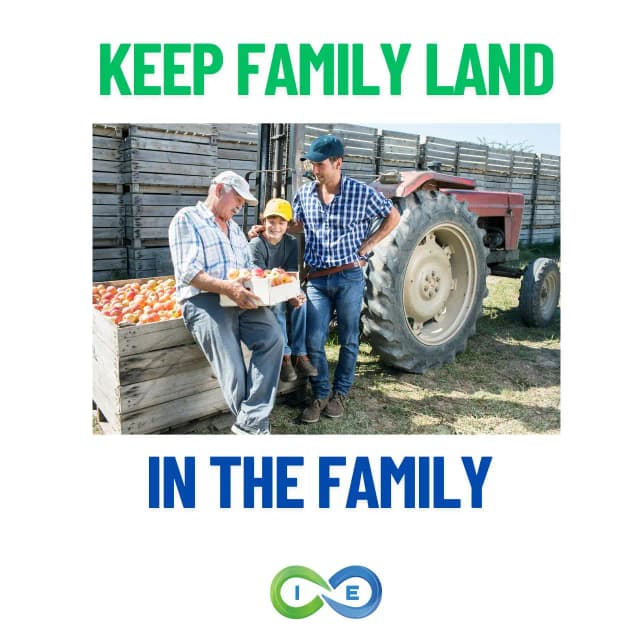
Land makes this concrete in a way portfolios rarely do. A portfolio can be liquidated with three clicks and the family is no worse off the next morning. Land has to be cared for. It rewards attention and punishes neglect. It carries the memory of the generations who worked it. Families who own land that has been in the family for decades or longer almost always speak about it the way stewards speak about something held in trust. They do not say I own this farm. They say we have this farm. The pronoun does the theological work for them. The article we wrote on how to keep family land in the family walks through the practical architecture for this, and the practical architecture exists precisely to protect against the moment when one generation forgets it is a steward and begins to behave like an owner.
The deeper point is that the steward posture has to be modeled. It cannot be lectured into a child. The parent who manages their wealth as a steward, who talks about it as a steward, who makes hard decisions as a steward, raises children who absorb the posture as native. The parent who treats the wealth as personal property and asks the children to be different than they are is asking for something the household has not produced.
The Infrastructure That Makes Formation Possible
Everything I have said so far is about the human work. The household. The work. The vocation. The stewardship. None of it requires an attorney or a financial advisor. A poor family with the right convictions can raise children who would steward whatever they were given.
That said, the families who actually have wealth to transfer face a problem that pure conviction does not solve. The wealth, once it is real, requires infrastructure. And the infrastructure is not optional, because without it, the wealth does what unstructured wealth always does. It dissipates at the first weak generation, the first lawsuit, the first divorce, the first poorly-timed liquidation to pay an estate tax bill.
So the question for any family serious about multi-generational transfer is not whether to build infrastructure. The question is what kind of infrastructure forms heirs rather than merely holding assets.
This is where the conventional wealth industry tends to default to portfolio management. A diversified portfolio, professionally managed, distributed according to a schedule, monitored by a corporate trustee. The infrastructure is essentially a holding pen. Wealth goes in. Distributions come out. The trustee enforces the rules the grantor wrote. The heirs are recipients of the arrangement. They are not really inside it. They cannot operate it. They cannot deploy it. They cannot be apprenticed into it. They can only receive what it pays out.
This is one reason why heirs raised under conventional dynasty structures often present as financially infantile in adulthood despite their wealth. They have never operated capital. They have only received it. The infrastructure was built to hold money safely, not to form the people who would inherit it.
There is a different model. It is older than modern wealth management and quieter than the family-office literature, but the families who use it tend to compound across generations in ways the conventional approach rarely produces. The model is a working family bank built on permanent life insurance, often held inside a properly structured trust, deployed as actual banking infrastructure for the family’s economic life.
What makes this different is that the heirs are not just beneficiaries. They are participants. They can borrow from the family bank to start a business, buy a home, weather an opportunity, finance an education. They repay the loans on real terms. They learn what it feels like to deploy capital and be accountable for it. The bank is a working environment, not a holding pen. By the time they are in their thirties, they have operated capital. They know what it means to borrow, to deploy, to repay, to grow. The formation that started in the household continues into adulthood through the infrastructure itself.
We have written at length about the legal and operational architecture of the family bank as a multi-generational wealth structure, including how it relates to dynasty trusts, the post-OBBBA exemption environment, and the difference between conventional dynasty planning and what we call a covenantal trust. The point here is simpler. The infrastructure has to be the kind that forms heirs while it holds wealth. The two jobs are not separable. A structure that only holds wealth without forming the people who will inherit it is a structure that has already failed. It just has not failed yet.
Generosity as the Final Test
The Stewardship section made a claim. The steward posture cannot be lectured into a child. It has to be lived in front of them until it becomes the air they breathe. That claim needs a test, because a posture you cannot verify is a posture you cannot rely on across generations.
Generosity is the test.
Not because giving is the highest virtue. Because giving is the only act that simultaneously requires all three things stewardship demands. It requires the heir to act as if they do not finally own what is in their hand. It requires them to decide what something is for, rather than simply consume it. And it requires them to do this without external coercion, because nobody can compel real generosity. An heir who can do all three has internalized the steward posture. An heir who cannot do any of them has not, regardless of what they say about values or what the trust documents require of them.
This is why other tests do not work as well. How an heir handles a setback reveals resilience, but a person can be resilient and still consume everything that comes to them. How they treat employees reveals character, but a person can be decent to employees and still treat inherited wealth as personal property. How they raise their own children reveals formation, but you only see the answer once it is too late to redirect. Generosity is the diagnostic that runs in real time, on whatever scale the heir is currently operating at, and gives you a reading you can act on while there is still time.
What does this look like operationally? You see it at smaller scale before larger scale. The heir who treats a server as a person rather than a function. The heir who gives time, which is harder than money, to people and projects that cannot pay them back. The heir who funds things quietly. These smaller instances are the same posture that, at larger scale, decides whether a family bank gets deployed as multi-generational infrastructure or liquidated into a third career.
The conventional wealth conversation treats generosity as the last chapter, the philanthropic strategy you bolt on after the accumulation and transfer work is done. The families who pass wealth across generations treat it differently. They treat it as the visible evidence that the formation took. If the heir can give freely, the steward posture is real. If the heir cannot, the household has more work to do, and no trust language will compensate for the gap.
Frequently Asked Questions
When should we start preparing our children for inheritance?
Earlier than you think and not in the way most advisors suggest. Formation begins by age five or six, not through inheritance conversations but through the household giving the child real responsibilities and real consequences. The financial conversations can wait until the late teens. The formation cannot. By the time most families think about “starting the conversations,” the foundation has already either been built or missed.
What is the difference between formation and financial literacy?
Financial literacy is information transfer. It teaches a person what a 401(k) is, how compound interest works, what a budget looks like. Formation is the slow shaping of a person into someone capable of stewarding anything at all. Financial literacy lands well on a formed person and slides off an unformed one. Most heir-preparation programs deliver financial literacy to people who were never formed, then express surprise when the wealth dissipates anyway.
What if our children are already adults and weren’t raised this way?
You do not get the early-childhood window back, but the work is not finished. Adult children can still be drawn into meaningful responsibility inside the family enterprise, given real decisions to make with real consequences, and apprenticed into the operation of capital rather than the passive receipt of it. The window is narrower and the formation is slower, but it is not closed. The mistake is to skip this step and try to compensate with more sophisticated trust language.
How much should we tell our children about the size of the family wealth?
This is the wrong question and asking it tends to reveal a deeper problem. Families who form heirs well tend not to treat the size of the wealth as a secret to be managed. They treat the existence of the wealth as a fact the household lives inside, with the children participating in age-appropriate ways from young ages. Children raised inside the operation know roughly what the household carries because they have been close to it. The dramatic “big reveal” conversation is a feature of households where the children were never inside the operation in the first place.
Does this mean we have to involve our kids in the family business?
Not necessarily. The point is not that every child works inside the family enterprise. The point is that every child grows up inside a household that has enough economic activity to apprentice them into real work at their developmental level. That work may or may not be the family’s primary enterprise. It might be land management, household operations, a side project, philanthropy. What matters is that the work is real, the responsibility is real, and the child is inside something rather than spectating from outside it.
How do we know if our heirs are actually ready to receive what we have built?
Watch how they handle small amounts of capital and small amounts of responsibility before you put large amounts in front of them. An heir who borrows responsibly from the family bank for a real purpose, repays the loan on terms, and treats the capital with care is showing you who they will be with larger amounts. An heir who cannot handle smaller scale will not be transformed by larger scale. The diagnostic is available years before the actual transfer, if you know to look for it.
Is this just a way of saying we should raise our children with values?
No. Values language is part of the problem. Values are abstractions that get talked about. Formation is concrete practice that gets lived. A family can have all the right values on paper and form their children in none of them. The question is not what the family says it believes. The question is what the household actually requires of the children, day after day, year after year. The values are downstream of that. So is the wealth.
Can a financial advisor or family office do this work for us?
No. A financial advisor can manage your assets, a family office can coordinate your professional team, and either can run useful family meetings. None of them can form your children. Formation is the work of the household, and it is not outsourceable. Where the advisors help is in building infrastructure that complements the formation, holding wealth safely while the family does the deeper work that only the family can do.
Next Step: The Generational Wealth Transfer Playbook
If this article has named something you have been sensing, the next step is the deeper playbook. Our Generational Wealth Transfer ebook walks through the complete architecture for transferring wealth to heirs who can actually receive it, including the legal scaffolding, the banking infrastructure, and the formation framework most families never hear about from conventional advisors.